90 Participants Joined the First Webinar on AI for Strengthening Monastic Communities
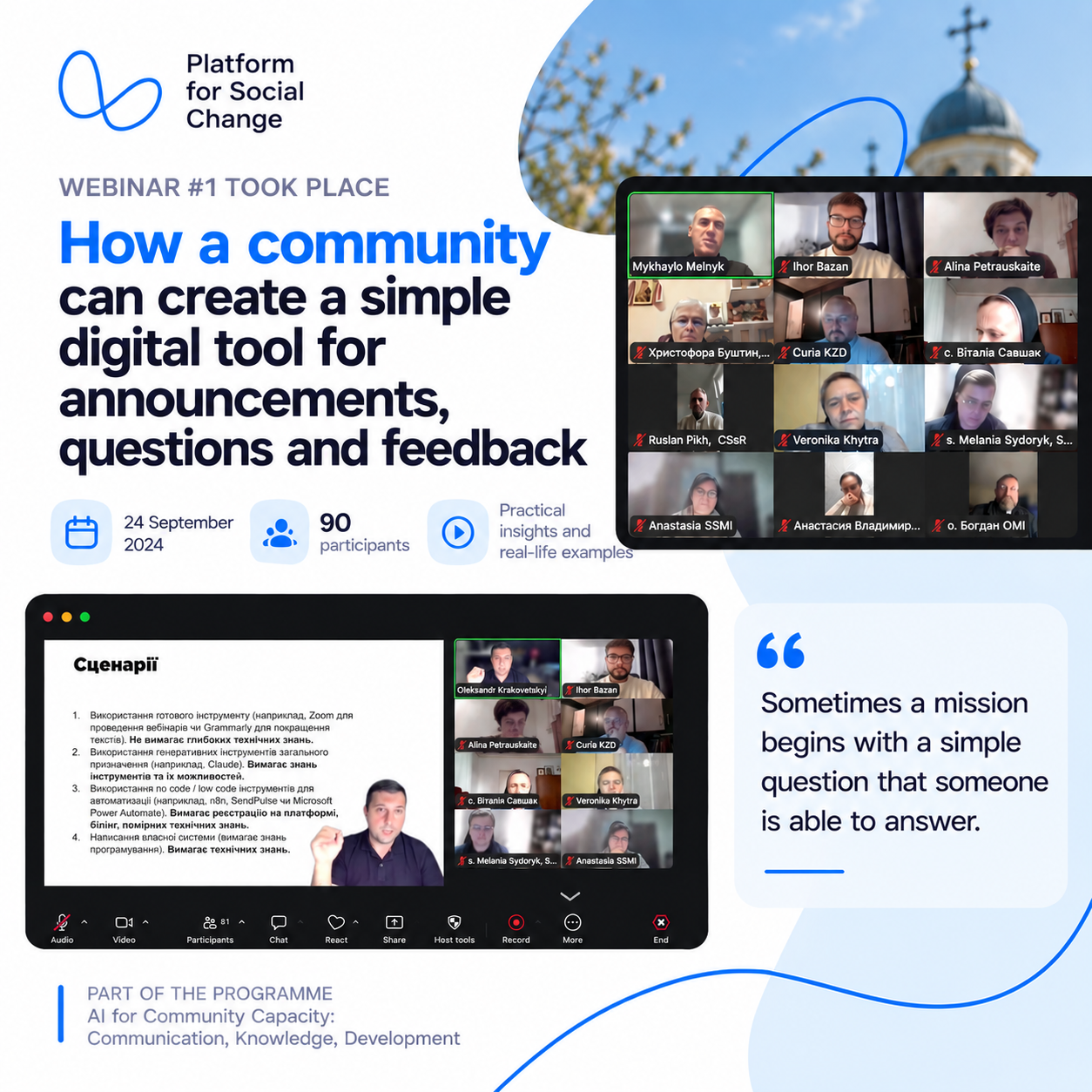
On September 24, Platform for Social Change held the first webinar as part of the programme “AI for Community Capacity: Communication, Knowledge, Development.” The online event brought together 90 participants to explore how AI and digital tools can support the everyday work of communities — and where technology should give way to human interaction.
The first webinar focused on “How a Community Can Create a Simple Digital Tool for Announcements, Questions and Feedback.”
The speakers were Fr. Mykhailo Melnyk, PhD, Executive MBA, PCC ICF Coach and Founder of Platform for Social Change, and Oleksandr Krakovetskyi, international AI expert, CEO of DevRain and Co-founder of DonorUA.
Digital communication as the “doorstep of a community”
The first part of the webinar focused on a question that comes before choosing any particular AI tool: why does a community need technology in the first place, and what should never be delegated to it?
Fr. Mykhailo Melnyk invited participants to think about digital communication as the “doorstep of a community.” Before entering a community or meeting its members in person, people often encounter it through a website, message, registration form, announcement or social media page.
This may be the first place where a person experiences clarity or confusion, attention or silence. Well-organised digital communication, therefore, is not only a matter of convenience. It can also be a practical way of showing care and attention to people.
At the same time, participants discussed the limits of automation. Repetitive and predictable requests can be simplified with technology. Situations involving pain, conflict, spiritual questions or the need for personal presence should remain a space for genuine human interaction.
Start with a real problem, not with AI
The practical part of the webinar was led by Oleksandr Krakovetskyi.
One of the key principles he emphasised was simple: do not start by asking, “Which AI tool should we use?” First, identify a specific process that takes too much time or could be improved.
Participants explored different levels of using digital technologies — from ready-made services and generative AI to no-code/low-code automation and custom-built systems. The session also covered knowledge bases, AI assistants, feedback analysis and the automation of repetitive processes.
For example, if a community regularly receives similar questions, there is no need to prepare every answer from scratch. Information can be organised into a knowledge base and used as the foundation for an AI assistant. Another example is processing large amounts of feedback: AI can help group responses by topic, identify recurring issues and prepare the information for further human analysis.
Technology should free up more time for people
One of the central ideas of the webinar was that AI should not replace people where human presence is needed.
Instead, technology can take over some repetitive tasks: finding information, structuring materials, preparing draft responses or automating individual processes.
This can free up more time for what cannot be automated — personal conversations, support, service and human connection. Participants were therefore encouraged to see AI not as a goal in itself, but as a tool for addressing specific challenges within their communities.
The programme continues on October 8
The first webinar brought together 90 participants. The next online session will take place on October 8 at 19:00.
Its topic will be “How to Create an AI Assistant for a Community’s Internal Knowledge and Frequently Asked Questions.” Participants will explore how to identify the materials that can form the foundation of such an assistant and develop a basic approach to using it.
Following the three webinars, Platform for Social Change also plans to invite interested communities to a free 4–6-week AI intensive programme. It will be designed for teams that have a specific challenge and are ready to work on a practical solution for their community.