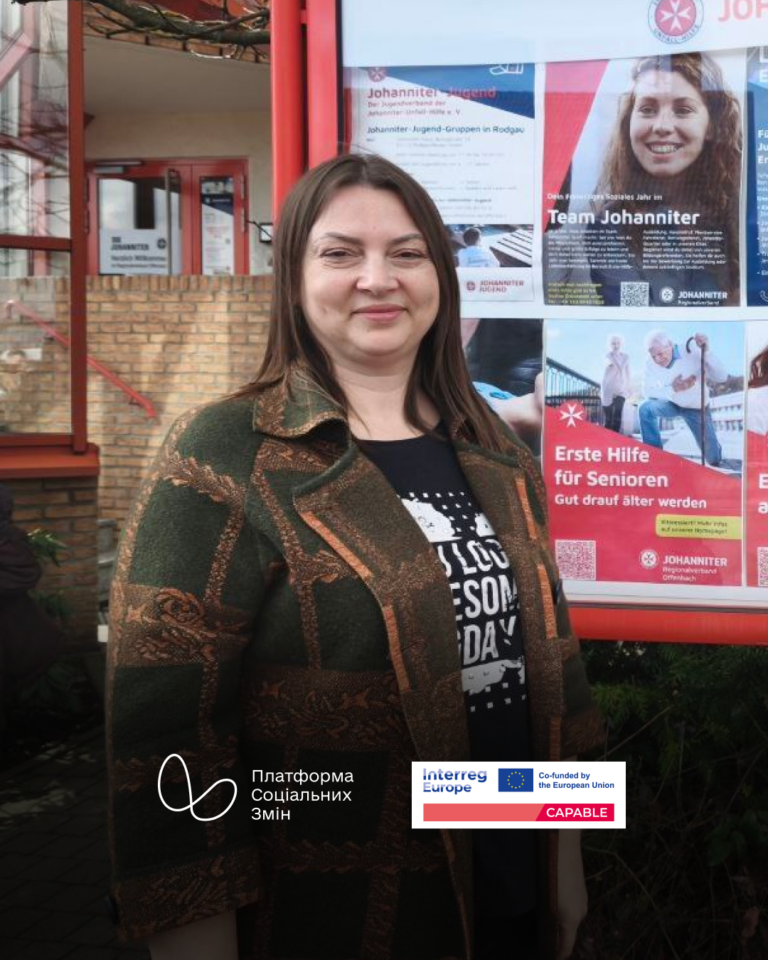
“I want social work in Ukraine to be alive.” The story of Nataliia Sivak and the impact of the Platform for Social Change
For Nataliia Antonivna Sivak, social work is not a professional term or a set of functions. It is a way of seeing a person. Of recognizing their dignity, potential, and right to support—regardless of age, status, or life circumstances.
Nataliia is an Associate Professor at the Department of Pedagogy at the Khmelnytskyi Humanitarian-Pedagogical Academy, the guarantor of the educational programme in Social Work, a researcher, lecturer, and coordinator of social initiatives. But above all, she is a person for whom family, identity, and humanity are the foundation of everything she does.
Her path into the social sphere began long before formal programmes or job titles. As a child in the town of Yarmolyntsi, she was friends with a girl with Down syndrome. When other children mocked her, Nataliia stood up to protect her. Back then, she did not yet know the word “inclusion,” but she already understood deeply that justice is an action.
Education as the foundation for change
Professionally, Nataliia has been connected with the Khmelnytskyi Humanitarian-Pedagogical Academy since 2003. In 2013, she defended her PhD thesis and later became an Associate Professor. In 2017, she was one of the initiators of the Social Work degree programme at the Academy and of the licensing documentation for submission to the Ministry of Education and Science.
Today, she serves as the guarantor of this educational programme. It was at this stage that her professional path naturally intersected with the Platform for Social Change.
A Meeting That Opened a New Perspective
Nataliia learned about the Platform for Social Change through personal connections. A colleague suggested she take a closer look at the organization’s work—and that recommendation became the starting point of a long-term, systematic collaboration.
For Nataliia, as a lecturer and programme guarantor, it was essential that students did not remain confined to lecture halls. She was constantly searching for live practice, real-life cases, and partnerships with the civic sector.
The Platform for Social Change became exactly that kind of space—one where learning was inseparable from practice, and theory immediately found its way into real life.
Even when the first round tables were held in Kamianets-Podilskyi and required travelling from Khmelnytskyi, there was no hesitation: “We’re going.” This was how a partnership began—built not on formalities, but on trust.
New Knowledge, New Solutions
Taking part in the activities of the Platform for Social Change opened up an entire field for Nataliia that she had previously had little direct experience with—working with older people.
Round tables, webinars, and the CAPABLE project did not offer abstract concepts, but concrete examples: how communities work with older adults, how they involve them in active social life, and how social services are designed and delivered in practice.
International speakers—particularly those from Poland—made an especially strong impression. They spoke about the use of IT technologies in the social sector: health-monitoring bracelets, emergency response systems, and tools to support people who live alone. For Nataliia, this was not an abstract vision of the “future,” but a very real response to Ukraine’s current challenges—population ageing, loneliness, and war.
It was at that moment that she clearly realised: without this kind of knowledge and these real-life examples, it is impossible to build a modern social system.
Impact Beyond the Classroom
One of the most powerful effects of working with the Platform for Social Change, Nataliia saw in her students.
After the first round table in Kamianets-Podilskyi, only one student traveled with her — a decision shaped by responsibility and fear of taking risks. Yet that very trip became a turning point.
After returning, the student prepared a presentation for Caritas in Khmelnytskyi, drawing directly on what she had heard during the Platform’s events. Her presentation was met with a standing ovation from representatives of the social protection department.
“At that moment, we felt like we had grown wings,” Nataliia recalls. “I realized: this is what real impact looks like.”
Later, almost the entire program took part in the second round table in Khmelnytskyi. It was there that the academy signed a memorandum of cooperation with the Platform for Social Change.
And soon after, a student who had helped organize the event chose the topic of her thesis: organizing leisure activities for older adults. Participation in a single event thus evolved into academic research — and a conscious professional choice.
The Role of an Educator Goes Beyond the Classroom
For Nataliia, the Platform for Social Change became a catalyst for rethinking the role of an educator. In her view, education is the foundation for life. But just as important is the kind of people students become when they leave university.
“I don’t know what professions they will choose,” she says. “But I want them to be people who care — people who can think critically and empathize with others.”
That is why the Platform’s formats — live discussions, roundtables, and real stories from communities — proved more impactful for students than any textbook.
Looking Ahead
Today, Nataliia sees the Platform for Social Change as a key partner in driving long-term, systemic change. This is not only about individual events, but about:
- high-quality professional development courses for social work professionals;
- training programs focused on working with veterans and people affected by war-related trauma;
- integrating social entrepreneurship courses into educational curricula.
“Social workers are the first line of support,” Nataliia says. “And they need modern knowledge that is adapted to Ukrainian realities.”
“Seeing the Person in Front of You”
When speaking about values, Nataliia articulates a simple yet deeply meaningful principle: to see the person in front of you. Not a role, not a status, not a label — but a human being.
This is the philosophy she passes on to her students. And, as she says, it is a philosophy strengthened by the Platform for Social Change — through partnership, trust, and working together.
This story is about how a platform can transform not only individual practices, but ways of thinking. And how, through one lecturer, one student, one roundtable, long-term change begins to take shape — in education, communities, and the social sector of Ukraine.