“I Clearly Understand How Important It Is to Support Others.” The Story of Change of Maryna Voloshchuk
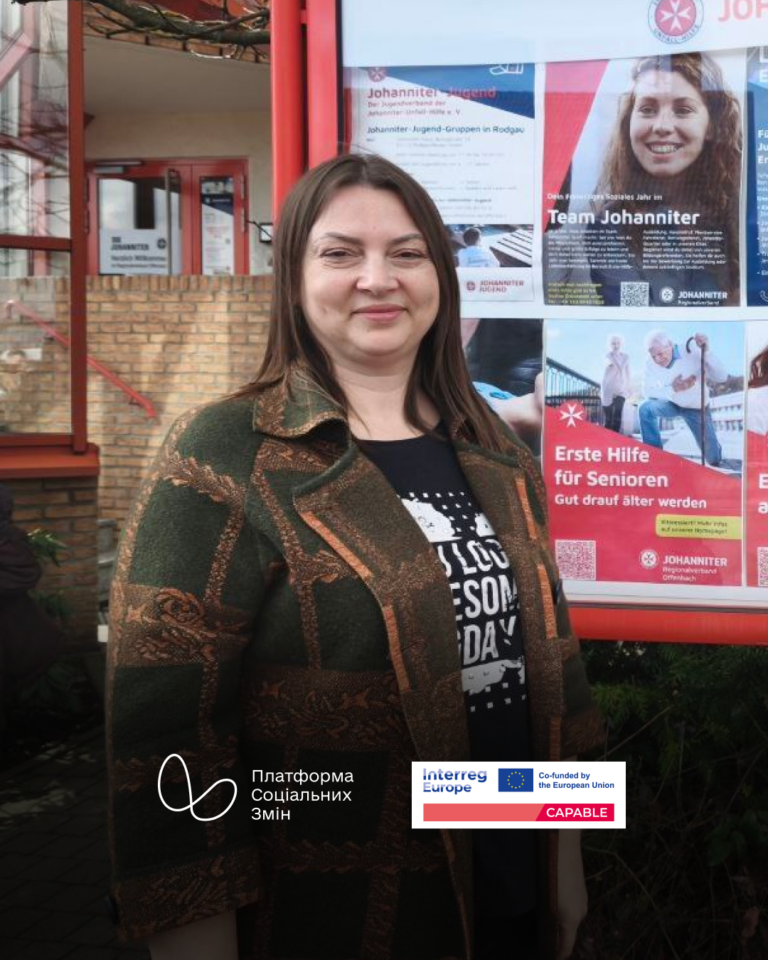
Maryna Voloshchuk lives on the outskirts of Kamianets-Podilskyi. Every day, she is immersed in both urban and rural life and clearly understands the challenges each of them faces. This experience has shaped her sensitivity to the needs of different people and communities.
By training, Maryna is a philologist. For the past eight years, she has been working at an educational and rehabilitation institution that combines education and rehabilitation for people with special educational needs. It is a space that serves children with special educational needs, orphans, children deprived of parental care, veterans, and older adults. The institution also works with adult learners participating in various academic programs and courses.
“This work is about people — of different ages, with different life stories, but with the same need for support, development, and the opportunity to be included in community life,” Maryna says.
Experience That Shapes Responsibility
Maryna initiated nationwide professional development courses in inclusive education and coordinated them with the non-governmental organization Center for Ukrainian and European Scientific Cooperation. More than one hundred participants took part in these courses. Training on resilience, emotional burnout, and professional burnout was also conducted.
She serves as the Head of the International Department and as a lecturer at the Department of Social Work and Sociocultural Activities named after Tamara Sosnovska. At one time, Tamara Sosnovska actively advocated for the rights and interests of people with disabilities in Kamianets-Podilskyi. At the institution where Maryna works, people with disabilities study as well, including those who use wheelchairs, so she has a deep understanding of their needs and practical experience in teaching and interaction.
Another vital area of her work is project-based activity. Maryna is a project manager within the Erasmus+ programme, including the MIND project focused on mental health, and she also takes part in developing the strategic plan for the educational institution. She is fluent in English and participates in numerous English-language conferences, international projects, and training programs.
She is exceptionally committed to working with older people, to social support, to social work, and to raising the prestige of the social work profession. That is why the CAPABLE project implemented by the Platform for Social Change became so important to her.

Personal Motivation and the Path to Inclusion
Maryna’s motivation stemmed from her personal experience. Like many people, she went through difficult moments in life and made a decision early on: if she obtained a higher education, she would dedicate herself to supporting young people.
At first, she imagined her future in a different direction — she dreamed of opening an English language school. After graduating from university, she spent some time tutoring and teaching. Later, she became involved in inclusive education initiatives — at that time, it was the Podillia Special College, which eventually developed into an institute.
It was there that Maryna became more deeply engaged with supporting young people with disabilities and individuals with special educational needs. The institution also hosted learning programs for older adults, including participants in the University of the Third Age. This experience broadened her perspective and encouraged her to explore new initiatives and European practices.
“Today, especially in the context of war, I clearly understand how important it is to support young people with disabilities,” she notes.
At the same time, Maryna is inspired by collaboration with young people themselves. They create civic organizations, initiate fundraising efforts, support others, and motivate those around them to keep moving forward.

Getting to Know the Platform for Social Change
Maryna first learned about the Platform for Social Change two years ago during the opening of the Youth Center in Kamianets-Podilskyi. It was there that she met Solomiia Boianovych, the Executive Director of the Platform. The presentation made a strong impression on her — not only because of its content, but also because of its live, sincere format.
“Offline communication is completely different. You see people’s emotions and feel how genuinely they care about developing ideas,” Maryna recalls.
Active cooperation between the Kamianets-Podilskyi State Institute of Higher Education, represented by Rector Marian Tripak, Dean of the Faculty of Socio-Psychological Activity, Rehabilitation and Vocational Education Oksana Palyliulko, and Head of the Department of Social Work and Sociocultural Activities named after T. Sosnovska Vasyl Moiseiuk, and the Platform for Social Change began in September 2025 and continues to this day. The experience of the Platform for Social Change is used within the Social Work educational programme, its educational components, teaching, and learning processes.
For Maryna, the Platform for Social Change became a space for learning and for developing youth initiative and engagement. It was here that she saw what formal education often lacks: practical experience, project-based thinking, and live interaction.
Maryna highlights the Platform’s webinars as particularly valuable — focusing on practical topics, digital tools, and the prestige of the social work profession. She actively incorporates this experience into her teaching, using examples from the Platform’s work during lectures and practical classes.

The Forum, Dialogue, and New Discoveries
Maryna also served as a moderator at the Forum of Social Change. She expected to need to guide the discussion actively, but the dialogue unfolded differently — participants shared their own experiences and developed the topics further.
“We stirred not only the city, but also the surrounding communities. There had never been such a lively dialogue before,” she shares.
During the Platform’s events, Maryna discovered numerous cases of project-based work and recognized the importance of cooperation between universities, communities, local self-government bodies, and civil society organizations. Webinars and roundtables helped her explore new approaches, and she describes the World Café format as particularly successful and effective.
Real Impact on Students and Communities
Maryna sees the impact of her work primarily in the changes among students. They discovered that social work is not limited to employment in state institutions but also includes volunteering, work with civil society organizations, initiatives, and project-based activities.
Students began to volunteer more actively, particularly with organizations that support older people with disabilities. For Maryna, this became clear evidence that the Platform for Social Change’s examples of cooperation and activities are effective in practice.
Today, this cooperation continues: a memorandum has been signed, the team is participating in consortia, and project proposals are being developed for Erasmus+ programmes.

Why Sharing Experience Matters
Maryna is convinced that the exchange of experience between communities is critically important, especially in the aftermath of the pandemic and in the context of war. Live communication helps people move beyond “tunnel vision,” see the bigger picture, and find solutions together.
“We see that we are not alone, that other communities face similar challenges. And we can learn from their solutions,” she says.
Words for Those Searching for Their Path
Addressing colleagues working in education, rehabilitation, and inclusion, Maryna encourages them not to be afraid of new opportunities, not to limit themselves within professional boundaries, and to develop project-based activities at both national and international levels.
“Today, there are many digital opportunities that help overcome barriers. There are far fewer of them than it may seem,” she concludes.
For Maryna, the Platform for Social Change has become a space for dialogue, practical experience, and informal communication — one that strengthens resilience in professional practice, civic engagement, and life overall.